
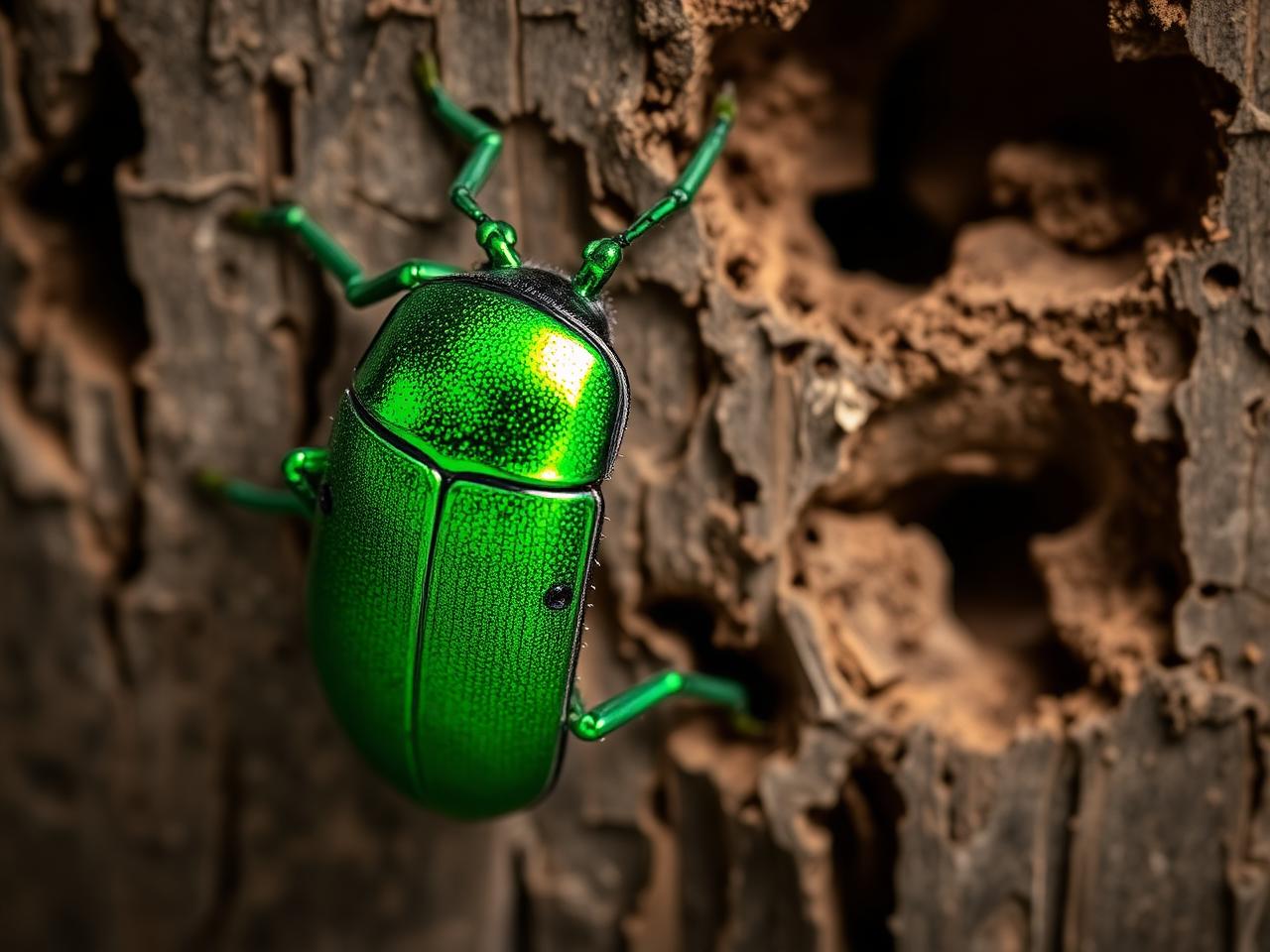
Emerald Ash Borer impact
Ash trees are popular trees in cities, towns, and acreages across Nebraska. Ash is a hardy tree that is adaptable to and tolerant of many different soils, and it makes up approximately 30% of mature trees in Nebraska.
In 2002, Emerald Ash Borer — an insect native to Asia — was discovered in Michigan killing ash trees. Since then, the insect and its destruction have spread to many states. In 2016, Emerald Ash Borer was confirmed in Nebraska, and it has spread across several counties. EAB will kill all North American ash trees and their cultivars, regardless of health, age, or size. This includes green, black, and white ash, and cultivars such as Patmore, Summit, and Autumn Purple.
Adult beetles fly during the summer and lay eggs on ash trees. Once hatched, the larvae tunnel beneath the bark. The dense network of tunnels restricts the tissue that carries sugars from the leaves to the roots. As the roots starve, less water moves up to the canopy, and the limbs and leaves at the top of the tree begin to decline. This process continues until the tree dies.
Signs your tree may be infested
Canopy dieback
- Begins in the top one-third of the canopy.
- Progresses until the tree is bare.
Bark splitting
- Vertical fissures on the bark caused by callous tissue formation.
- Galleries exposed beneath the bark splits.
- Loose or falling bark.
Serpentine galleries and D-shaped exit holes
- Galleries weave back and forth across the wood grain in a zig-zag pattern.
- Sawdust, frass, or excrement around the tree.
- Adult beetles leave D-shaped holes when they emerge.
Increased woodpecker activity
- Several woodpecker species feed on EAB larvae.
- Pecking on the outer bark.
- Larger holes created when extracting insects and larvae.
Shoots or sucker limbs
- Sprouts growing from the roots and trunk.
Mushrooms and internal decay
- Mushrooms are a sign of decay; with EAB, decay starts on the inside.
- Often found in the upper limbs or canopy.
Warning: brittle trees fall fast
Trees and branches killed by Emerald Ash Borer become brittle quickly and rot from the inside out. They create a high hazard and can start to fall in as little as a year. Ash trees should not be left standing until they are dead or have significant dieback.
Treatment vs. removal
Trees already infested with EAB may be treatable if the damage is not severe. Trees with more than 50% canopy loss will likely not recover. In some communities, removing infested trees may be mandatory.
Considerations against treatment
- Many insecticides used to treat ash trees are toxic to pollinators.
- Soil drenches can reduce beneficial soil organisms such as earthworms.
- Soil drenches can't be used on flowering plants around the base of a tree.
- Treatments can be expensive and must continue for the life of the tree — typically every one to two years for injections.
- Trees must be in relatively good health to move the insecticide into the upper canopy, and treatment is not a guarantee of survival.
- Treatment won't correct other stressors affecting the tree.
Considerations for treatment
- Important landscape or historic trees can be protected with treatments.
- Treatments can buy time when a homeowner isn't ready to remove a tree yet.
- Treatments can make sense for high-value, healthy trees.
- Treatments may be cheaper in the short term than removal — though the tree may still need to come down later.
Regardless of the decision, ash trees should not be left standing until they are dead or significantly declined. Once EAB is found within 15 miles, the decision should be made to treat or remove. Preemptive removal and replanting before that point is also an option.
Get a Free EAB Consultation
A Nebraska Certified Arborist will visit your property and help you weigh treatment versus removal for your ash trees.